From Three Weeks to Four Days: How We Accelerated Operator Integrations in iGaming

A case study on how a seemingly routine iGaming operator integration turned into a test of speed, and how we passed it without bypassing the client’s mandatory reviews and CI/CD checks.


Operator Integrations in iGaming for B2B game provider

21 operator integrations, ~1,500 RPS total

TEAM

2 engineers on the case, 7 across 9 integrations per quarter

PERIOD OF COLLABORATION

2025-2026

CLIENT’S LOCATION

EU, LATAM, Philippines, Armenia, UK

The Client: The Platform Was Ready, but Every Integration Started from Scratch

There was no need to start from the ground up or rewrite legacy systems, given that the client had put in place a production-ready platform and its integration patterns. By the time of this case, the platform was doing some 1,500 RPS in total and had 21 operator integrations across 5 regulated jurisdictions to its credit. In the quarter prior, a seven-engineer team had put 9 of those in place.

What presented the bottleneck was the process. One has to contend with the contract each new partner or operator presents, and it is not uncommon for an integration to run to three weeks if one is fortunate enough to have approvals come through on time.

Key Project Outcomes

icon

4 business days from receiving the API documentation to production release

icon

9 integrations delivered in one quarter by a team of 7 engineers

icon

30% fewer integration-related incidents after release


The Challenge: Why an Operator Integration Could Derail the Launch

An operator is not in a position to go live with an integration of this sort until the commercial launch is at hand. Hence, one does not ask if it can be done, only whether the deadline can be met. Writing the adapter was hardly the problem; getting the API contract and infrastructure in step with the environments and the way external services behave was.  The platform’s integration patterns were tried and true, yet they did not entirely accommodate the forthcoming contract. There were a number of loose ends to be tied up before any request of substance could be put through without issue.  These three were what presented themselves most frequently:

1

Every contract is different.

Proven integration patterns can be reused, but the specific API contract almost always has its own differences: new fields, different error-handling logic, different assumptions about player sessions.

2

In this case, the documentation did not fully match reality. 

The client does not control the behavior of a third-party API, and it can only be verified in the sandbox, often when the operator is already waiting for the result.

3

A working integration is more than just application code. 

Deployment configuration, networking, environment variables and parameters, databases and migrations, messaging topics and ACLs, Argo CD configuration - all of these must align across environments before the first successful request.

4

We were given a fortnight to put this integration together, a commercial deadline of the client’s that was not open to discussion. The whole affair was part of a process with players and money in the mix. 

So the release could be derailed on account of something having nothing to do with the merits of the integration code.

The Solution: One Team Owns the Entire Process

We handle each integration as a single end-to-end process: one team is responsible for the entire journey, from environment preparation to the production release, instead of passing the work between departments one after another.
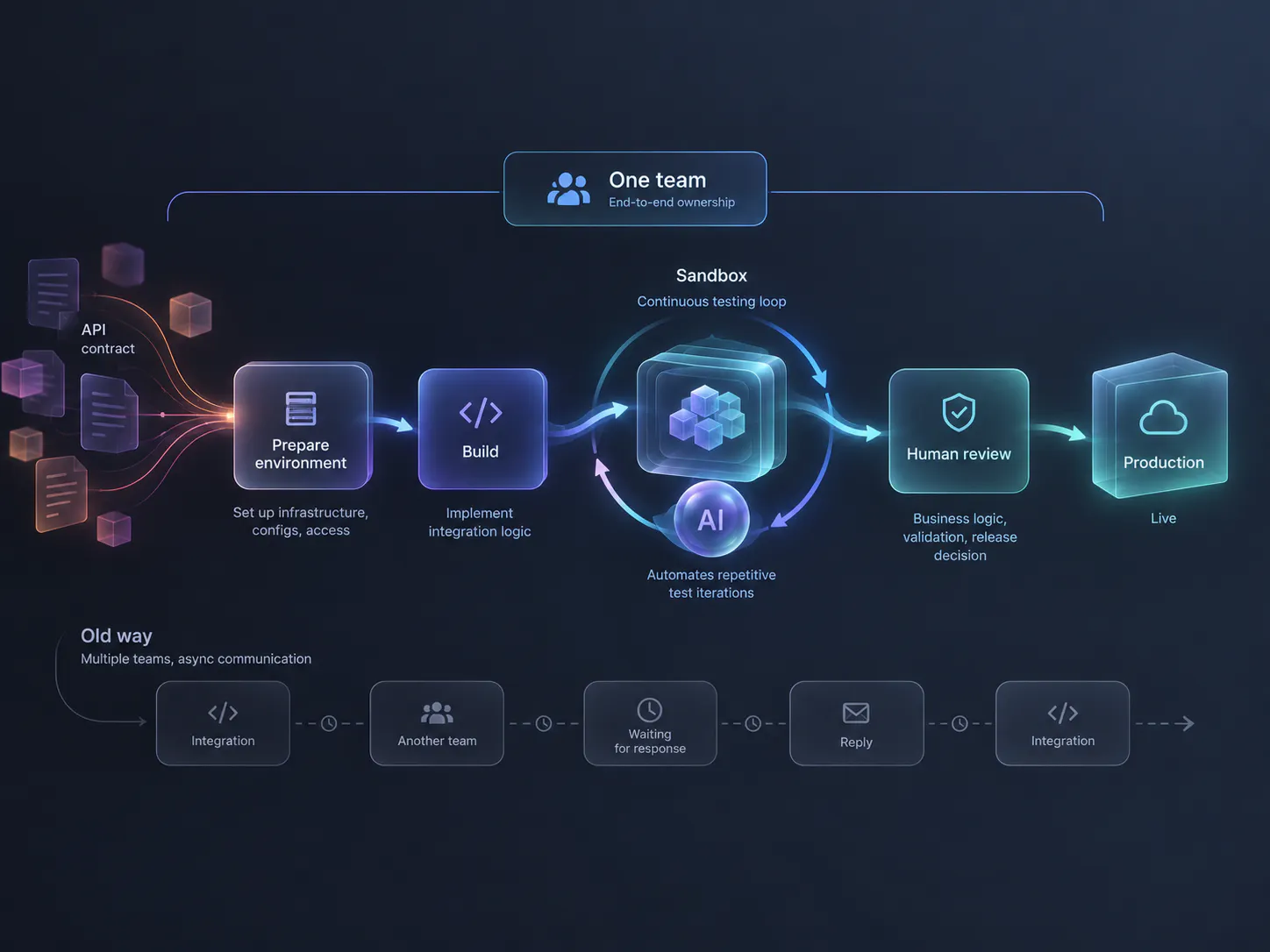
 One Team Owns the Entire Process

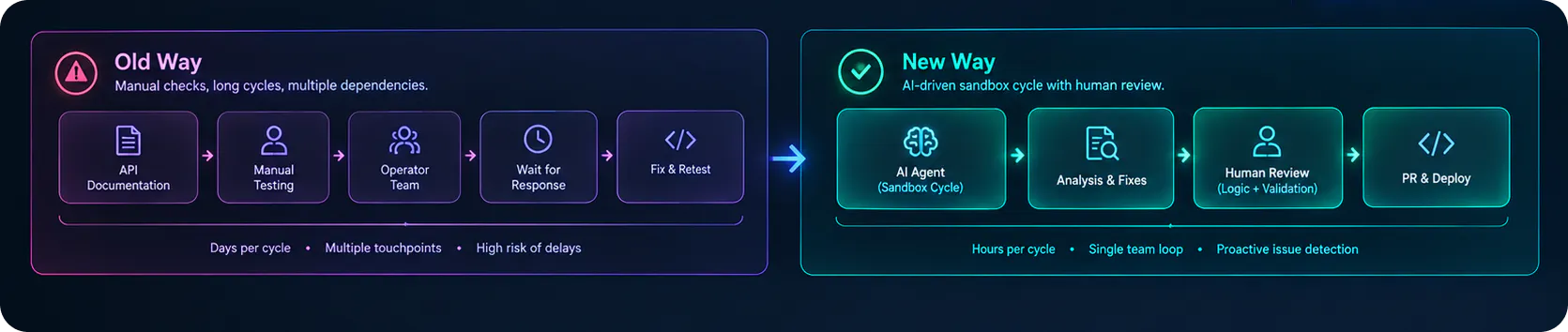
In the standard process, the main delay came not from the complexity of the code, but from asynchronously resolving discrepancies: the team would identify a mismatch between the specification and the sandbox and wait for a response from the operator’s team - often for several days per cycle.

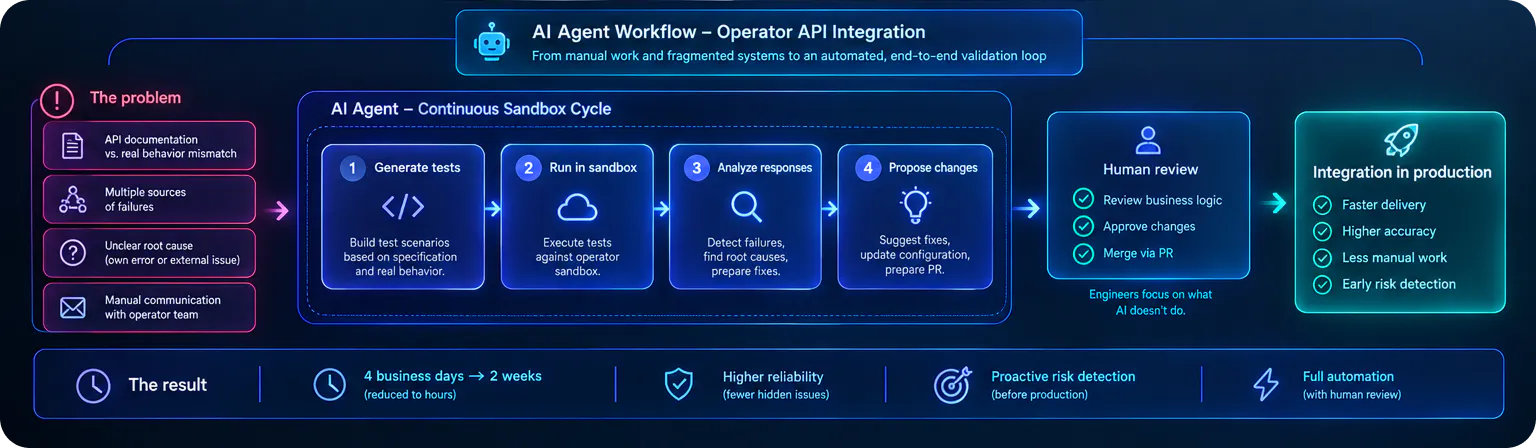
For this integration, we eliminated that waiting: we replaced back-and-forth communication with a direct, controlled validation cycle against the sandbox, in which an AI agent handled some of the repetitive testing iterations. The engineers remained responsible for what the agent does not do: transaction business logic, reviews, and release decisions.

This was not a release outside the standard process: the team had already used a similar approach for other operator integrations, although the exact timeline always depends on the contract and the readiness of the external API.
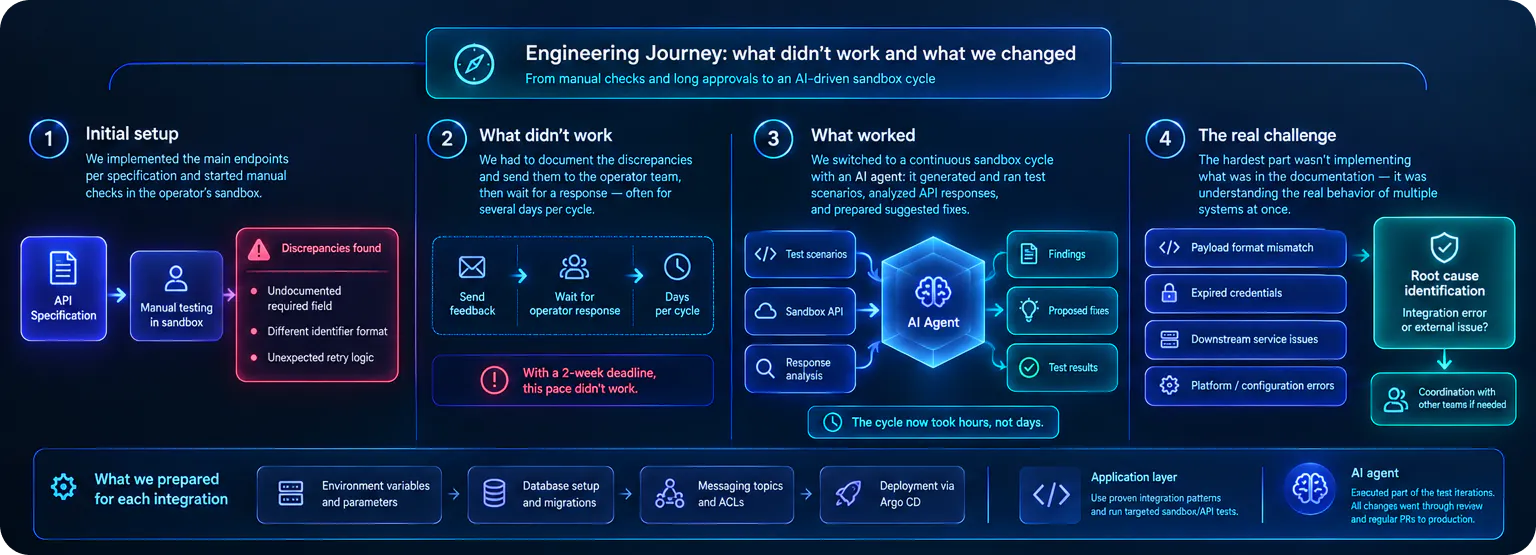
Engineering Journey: What Didn’t Work and What We Changed

The team implemented the core endpoints according to the specification and began manual testing in the sandbox. It immediately became clear that the API’s actual behavior differed from the documentation: an undocumented required field, a different identifier format, and retry logic that did not match the documented status codes.

What didn’t work: the standard process in such cases is to document the discrepancies, send them to the operator’s team for clarification, and then wait for a response - often several days for each cycle. With a two-week deadline, that pace simply did not fit the schedule.

To avoid losing days to back-and-forth communication, we rebuilt the validation process as a continuous sandbox cycle: an AI agent generated and ran test scenarios directly against the operator’s sandbox, analyzed API responses, and prepared proposed fixes.

What worked: the cycle that had previously depended on responses from the operator’s team was closed within the Alpacked team - it began taking hours instead of days. Engineers focused on what the agent does not do: reviewing transaction business logic and giving final approval to changes. That was where they identified a risky assumption in the retry logic - before it reached production.

The Hardest Part: Our Error or Someone Else’s Failure?

The hardest part was not implementing what was written in the API documentation, but reconciling the actual behavior of several systems at once.

A request in the sandbox could fail for a dozen different reasons, and from the outside all failures looked the same - simply “something didn’t work.” But the cause was different each time: an incorrect payload format, an expired credential, or a downstream service behaving differently from what was documented at that particular moment.

Before handing off a fix to anyone, we had to quickly determine whether the issue was in the integration implementation itself or a failure in the platform, configuration, or external API. Guesswork cost time - we needed evidence.

When the root cause was outside the integration itself, we had to coordinate changes with another team, the owner of the service, rather than simply fixing something locally and hoping it would help.

What We Prepared for the Integration

For each integration, we prepare a separate set of platform configurations: environment variables and parameters, database preparation and migrations, messaging topics and ACLs, and deployment configuration in Argo CD.

At the application level, we do not design the adapter from scratch; we compare the specification against proven integration patterns and run targeted sandbox/API tests. These tests capture failures and service responses, and the results feed directly into the next development iteration.

In this case, an AI agent handled some of the testing iterations, but every proposed change went through review, and all changes reached production through a standard pull request.

Stack

  • API and documentation: REST/JSON, OpenAPI
  • Development and CI/CD: Git + pull request workflow, Docker, automated integration tests, CI/CD, Argo CD
  • Data and integrations: databases and migrations, messaging topics/ACLs
  • Environments: operator sandbox environments, network configuration, environment variables

Result: Faster, More Stable, Without Unnecessary Costs

All this sandbox tracing, coordination with external teams, and the continuous validation cycle translated into concrete results:

1

Technical

  • The deadline stayed fixed: two weeks for everything, and 4 business days to release
  • The approach was not a one-off: a team of 7 engineers applies it to every integration and delivered 9 integrations this way in one quarter
  • Fewer issues despite increased speed: integration-related post-release incidents across this portfolio decreased by 30%
  • No controls were bypassed: changes went through the client’s standard PRs, reviews, and CI/CD checks

2

Business

  • The commercial launch stayed on track despite the two-week deadline
  • Accelerating the process did not require a significant expansion of the production infrastructure
  • Accelerating the internal process did not change the client experience: after launch, game and session flows operated as usual

Every week an integration is not ready is a week when the commercial relationship with the operator simply does not work. So the main savings here are not in infrastructure, but in the amount of time between signing the contract and seeing the first players arrive from the new operator.

Have a Similar Deadline?

Tell us which operator or partner you’re working with and how much time you actually have. We’ll see whether the same process can be completed faster without putting production stability at risk.

Let's arrange a free consultation

Just fill the form below and we will contaсt you via email to arrange a free call to discuss your project and estimates.

Read other cases