Recovery Time Cut by 98% Through Automated Domain Managementย ย 

How we reduced iGaming service recovery time after a domain block from 12โ€“14 hours to 5โ€“15 minutes.


Casino domain management system

How we reduced iGaming service recovery time after a domain block from 12โ€“14 hours to 5โ€“15 minutes.

TEAM

1 DevOps Engineer

PERIOD OF COLLABORATION

2026

CLIENTโ€™S LOCATION

EU

Online casino verification service (NDA)

Our client is an iGaming verification service (NDA). Before the engagement, the infrastructure had a significant limitation: the primary domain was integrated across multiple system components, making domain replacement or the addition of a new domain dependent on numerous manual changes. As a result, such operations could lead to service downtime lasting 12โ€“14 hours.

The issue became critical when the domain registrar ran into technical problems on their end, making the primary domain unreachable in one of the client's key markets. The registrar resolved its own issue a couple of weeks later and the domain came back on its own - but the company couldn't afford to wait weeks for a third party to fix the problem, or count on it resolving at all next time. It needed a way to restore access within minutes, on its own terms.

Key Project Outcomes

icon

๐—™๐—ฟ๐—ผ๐—บ ๐Ÿญ๐Ÿฎโ€“๐Ÿญ๐Ÿฐ ๐—ต๐—ผ๐˜‚๐—ฟ๐˜€ ๐˜๐—ผ ๐Ÿฑโ€“๐Ÿญ๐Ÿฑ ๐—บ๐—ถ๐—ป๐˜‚๐˜๐—ฒ๐˜€. Service recovery time after a domain block.

icon

๐Ÿญ๐Ÿฎ ๐—ต๐—ผ๐˜‚๐—ฟ๐˜€ ๐—ผ๐—ณ ๐˜„๐—ผ๐—ฟ๐—ธ ๐—ฏ๐˜† ๐Ÿฑ ๐—ฝ๐—ฒ๐—ผ๐—ฝ๐—น๐—ฒ โ†’ ๐—ผ๐—ป๐—ฒ ๐—ฐ๐—น๐—ถ๐—ฐ๐—ธ. Domain replacement without involving developers or DevOps engineers.

icon

๐—” ๐—ธ๐—ฒ๐˜† ๐—บ๐—ฎ๐—ฟ๐—ธ๐—ฒ๐˜ ๐—ฝ๐—ฟ๐—ฒ๐˜€๐—ฒ๐—ฟ๐˜ƒ๐—ฒ๐—ฑ. The risk of losing contracts following the domain outage was eliminated.


A Single Domain Block Meant 12 Hours of Downtime and the Entire Team Getting Involved

The main challenge was that every domain block turned into a lengthy and complex recovery process. Instead of restoring service within minutes, the company spent hours resolving a single incident, requiring the involvement of the entire team.

1

1. Reputational Risks for the Client and the Service

The verification certificate was displayed on online casino websites as proof that they had successfully passed the verification process. Once the service domain became unreachable, the certificate could no longer be displayed, negatively affecting the reputation of both the casino operators and the verification service itself. The platform serves 236k users and 70k casinos - and losing access in that market put contracts with one of the client's largest customer segments, and the trust of a large share of that user base, at risk.

2

2. Architectural Limitation

A single domain was hardcoded across dozens of system components, including the application code, database, content, and other parts of the platform. An operation that should have taken only a few minutes instead turned into a technical process lasting several hours.

3

3. No Rapid Recovery Mechanism

Without a centralized domain management mechanism, the company was unable to respond quickly to unexpected domain blocks. Every incident required the immediate involvement of developers, DevOps engineers, and management, regardless of the time of day.

"Find a solution as quickly as possible so that when this happens again, we no longer have to worry website owners."

This was how the client summarized the primary requirement after another incident: build a solution that would allow future domain blocks to be handled without the immediate involvement of the technical team and without disrupting casino operators.

From Manual Response to Automated Domain Management

Rather than implementing a temporary fix, we built a solution that eliminated the root cause of the problem and made future domain blocks fast and easy to manage. The work focused on three key areas.
Platform Stabilization

We quickly restored the service to minimize the business impact of the incident.

Eliminating Architectural Dependencies

We analyzed the entire system, identified every location where the domain was tightly integrated, and removed those architectural dependencies.

Automated Domain Management

We developed the Domain Management Platform, a dedicated management layer that applies domain changes automatically at the infrastructure level. Adding, replacing, or switching a domain can now be completed with a single click in about five minutes, without modifying the application code or involving the technical team.
How We Eliminated the Dependency on a Single Domain

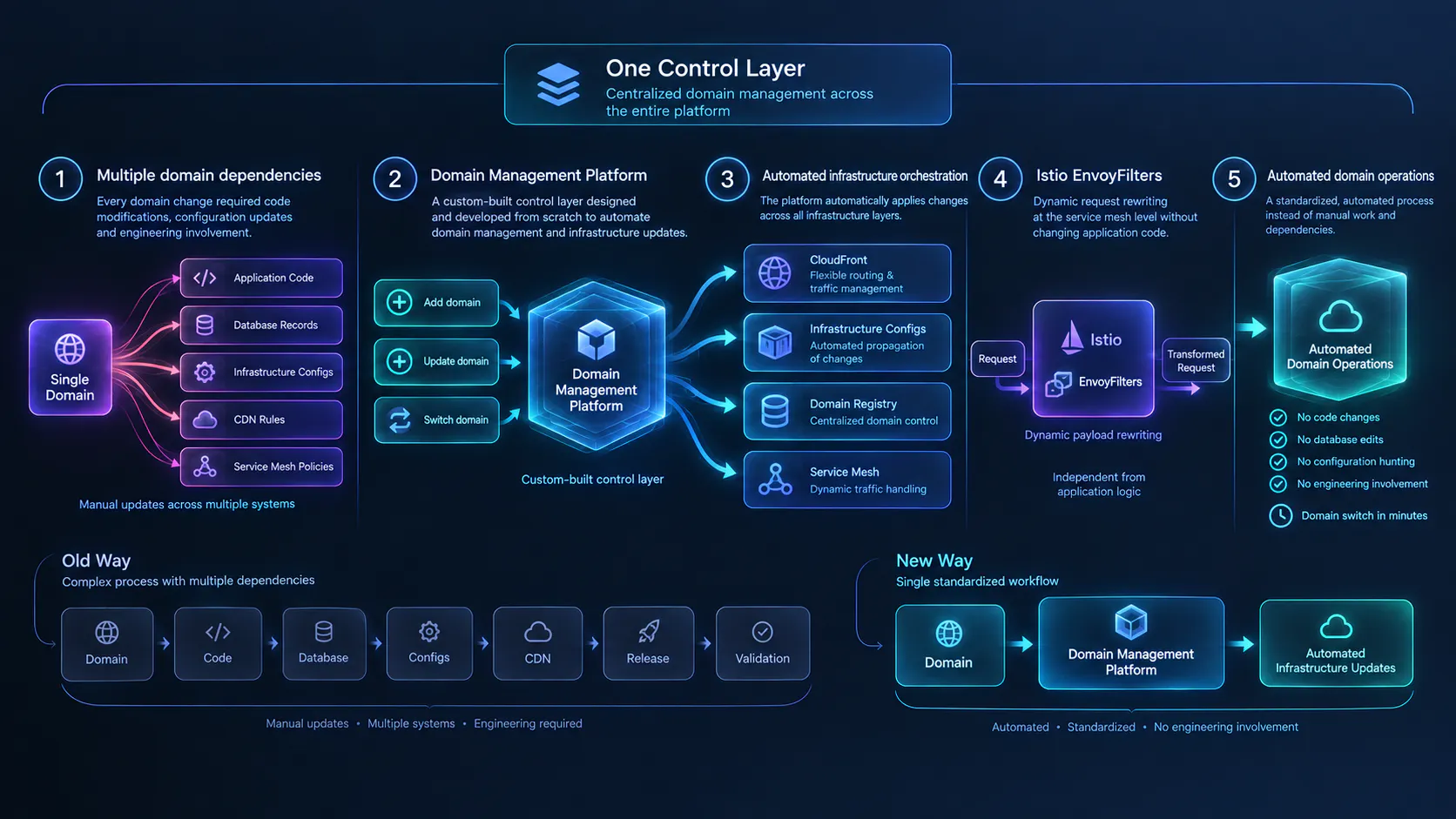
The Domain Management Platform is a fully custom solution designed and built from scratch. It automates domain configuration management and the application of changes across different infrastructure components. The system separated domain management logic from the platform's internal components and eliminated the need to manually modify application code, the database, or configurations every time a domain changed.

The platform became a dedicated management layer responsible for applying changes at the infrastructure level. Instead of searching for and updating dozens of dependencies, the team gained a standardized process where all operations are performed automatically according to predefined rules.

To implement this, we used Amazon CloudFront, where flexible routing and request-processing rules were configured. This made it possible to control traffic behavior at the content delivery network level and apply the required changes without rebuilding the application.

We also used Istio EnvoyFilters for dynamic payload rewriting at the service mesh level. This made it possible to modify the required data while requests were being processed without changing the application code, making the domain-switching process independent of the system's internal logic.

As a result, the domain replacement process was transformed from a manual operation with multiple dependency points into a standardized, automated workflow.


Architecture Changes

1

Before the Solution

  • The domain was integrated across multiple system components.
  • Manual changes were required in the application code, database, and configurations.
  • Domain replacement took several hours.
  • The process depended on developers, DevOps engineers, and management.
  • There was a high risk of repeated downtime.

2

After Implementation

  • Centralized domain management.
  • Automated application of changes.
  • CloudFront and Istio for dynamic request routing.
  • No manual code changes required.
  • The business became independent of the technical team when responding to future domain blocks.

Technology Stack

Cloud & Infrastructure

  • AWS, Amazon EKS, Amazon CloudFront, AWS WAF, Amazon Route 53, AWS Certificate Manager, Elastic Load Balancer, Amazon ECR, AWS Secrets Manager

Service Mesh

  • Istio EnvoyFilters

Business and Platform Impact

What Changed in the Infrastructure

  • Recovery after a domain block: 12โ€“14 hours โ†’ 5โ€“15 minutes.
  • Domain replacement: searching for dependencies across the application code, database, and configurations โ†’ zero manual changes.
  • Domain switching: involvement of five people โ†’ fully automated process with no downtime and no manual errors.

What This Delivered for the Business

  • Downtime was reduced by 98%.
  • Domain management was transferred to the business team without requiring the involvement of the technical team.
  • The company can now prepare in advance for restrictions in new regions instead of reacting after they occur.

Let's arrange a free consultation

Just fill the form below and we will contaัt you via email to arrange a free call to discuss your project and estimates.

Read other cases