DevOps practices in iGaming are the engineering habits that keep real-money platforms available, consistent, and auditable under unpredictable traffic: domains managed as configuration, templated operator integrations, idempotent wallet transactions, releases that roll back on bet and deposit metrics, and autoscaling on request and queue signals.
2 a.m., Tuesday. A registrar experiences a technical failure, and your primary domain stops working in your largest market. There is no match or promotion underway, yet the platform is already unavailable to players. Teams usually prepare for major events, but in our experience, situations like these catch them off guard.
Peaks keep growing. For the 2026 World Cup, Flutter Entertainment expected up to 100,000 bets per minute at peak moments across its platforms, Reuters reported. Every major tournament and seasonal promotion now creates the same kind of spike.
We manage infrastructure for game providers, iGaming platforms, and the B2B services surrounding them. This is not an overview of every DevOps tool, but rather three practices whose absence, in our experience, costs iGaming companies the most. For each, we'll cover the problem, the chosen approach, its limitations, and the results. At the end, we'll provide a checklist for evaluating a DevOps contractor or your in-house team.
Where iGaming Platforms Lose Money: Three Infrastructure Risks
In our experience, the most costly problems come from three areas, each addressed by a separate practice below:[object Object]
- Domain unavailable in a key market. If the domain is hardcoded throughout the system, recovery takes hours, putting contracts at risk.
- Integration with a new operator takes weeks. The contract is signed, but every week of delay means another week without revenue.
- A release or traffic spike on a live platform. The question is not just whether the platform can handle the load, but whether every bet and every payment will be processed correctly.
Practice 1. Domain Outages: How to Reduce Recovery Time from Hours to Minutes
A domain is one of the most fragile points of an iGaming platform. It's easy to leave it out of the recovery plan: it's simply there until one day it stops working.
Why Replacing a Domain Took 12 Hours: A Casino Verification Service Case Study
Our client is a verification service for online casinos. Casinos display its certificate on their websites as proof that they have passed verification. The platform serves around 236,000 users and 70,000 casinos.
One day, the registrar experienced technical issues, and the primary domain became unavailable in one of the key markets. Certificates stopped appearing on casino websites, putting the reputation of both the service and the operators at risk.
A few weeks later, the registrar fixed the issue, and the domain came back online on its own. But the client couldn't afford to wait weeks or rely on the next issue resolving itself.
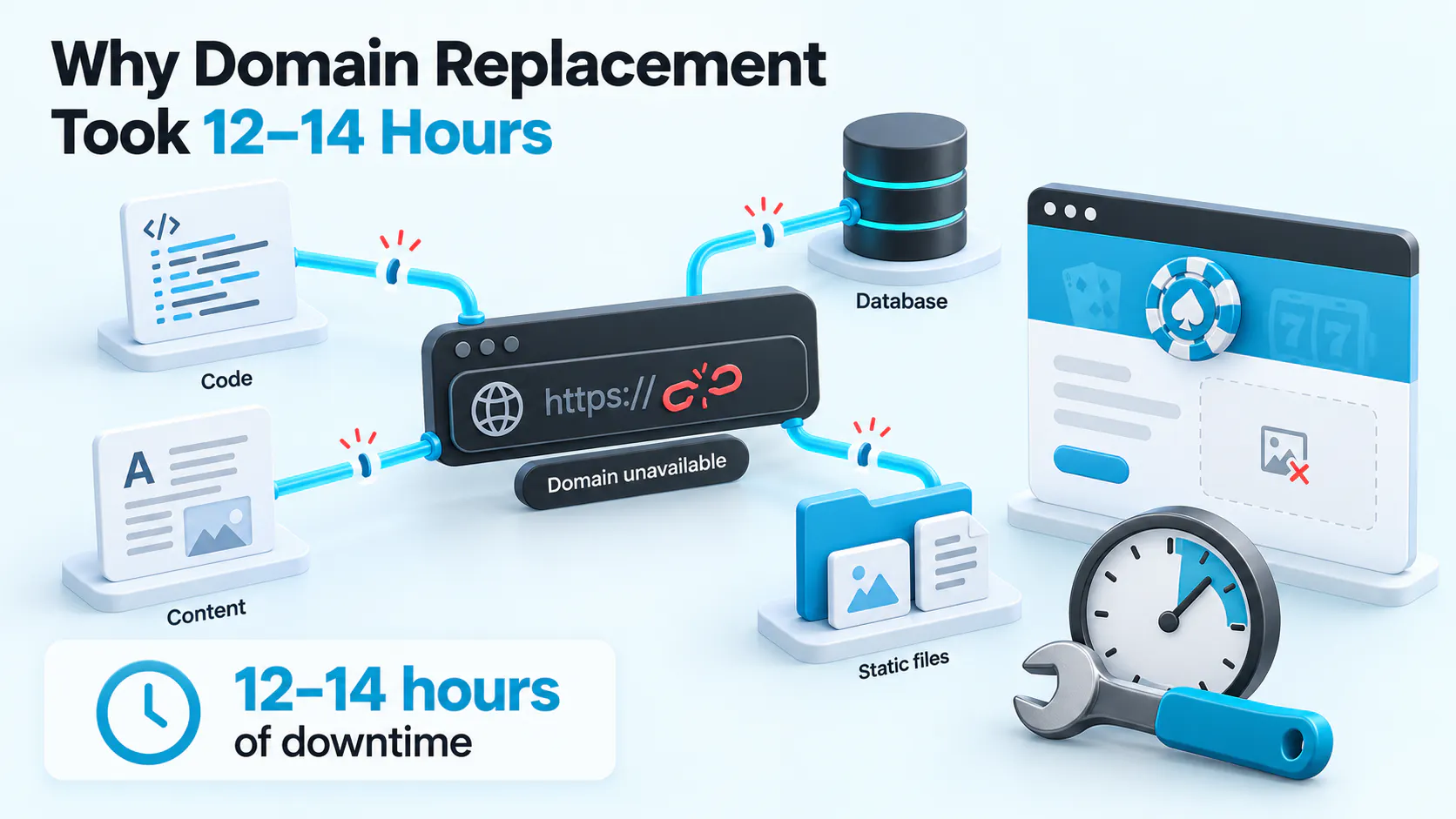
The main challenge wasn't the registrar. The domain was scattered throughout the system: in the code, database, article content, and static files. Every replacement meant finding all these references and making manual changes: 12–14 hours of downtime, with developers, DevOps engineers, and management on a call, regardless of the time of day.
Why On-the-Fly Request Rewriting Didn't Work
In the first few hours, we tried the quickest option: setting up an additional domain and configuring on-the-fly request rewriting. It didn't help. The old domain remained in the database, articles, and static files, so parts of the system continued pointing to the unavailable address.
This attempt revealed the core issue: the domain wasn't just an entry point to the system. Any local fix meant searching again for every place where the domain was referenced, and repeating the process with every subsequent incident.
Solution: Domain as Managed Configuration at the CDN and Service Mesh Levels
We stopped treating the domain as a constant and turned it into managed configuration:
- Removed hardcoded dependencies. We went through the entire system, identified every place where the domain was hardcoded, and decoupled those dependencies.
- Moved domain management to a separate layer. Routing rules at the CDN level (Amazon CloudFront) allow traffic behavior to be changed without rebuilding the application.
- Configured response rewriting in the service mesh. Using EnvoyFilter in Istio, we configured the rewriting of the necessary data in responses without modifying the application code.
- Handed over domain switching to the business team. Adding, replacing, or switching a domain at the infrastructure level now takes approximately five minutes, without involving developers or DevOps engineers.