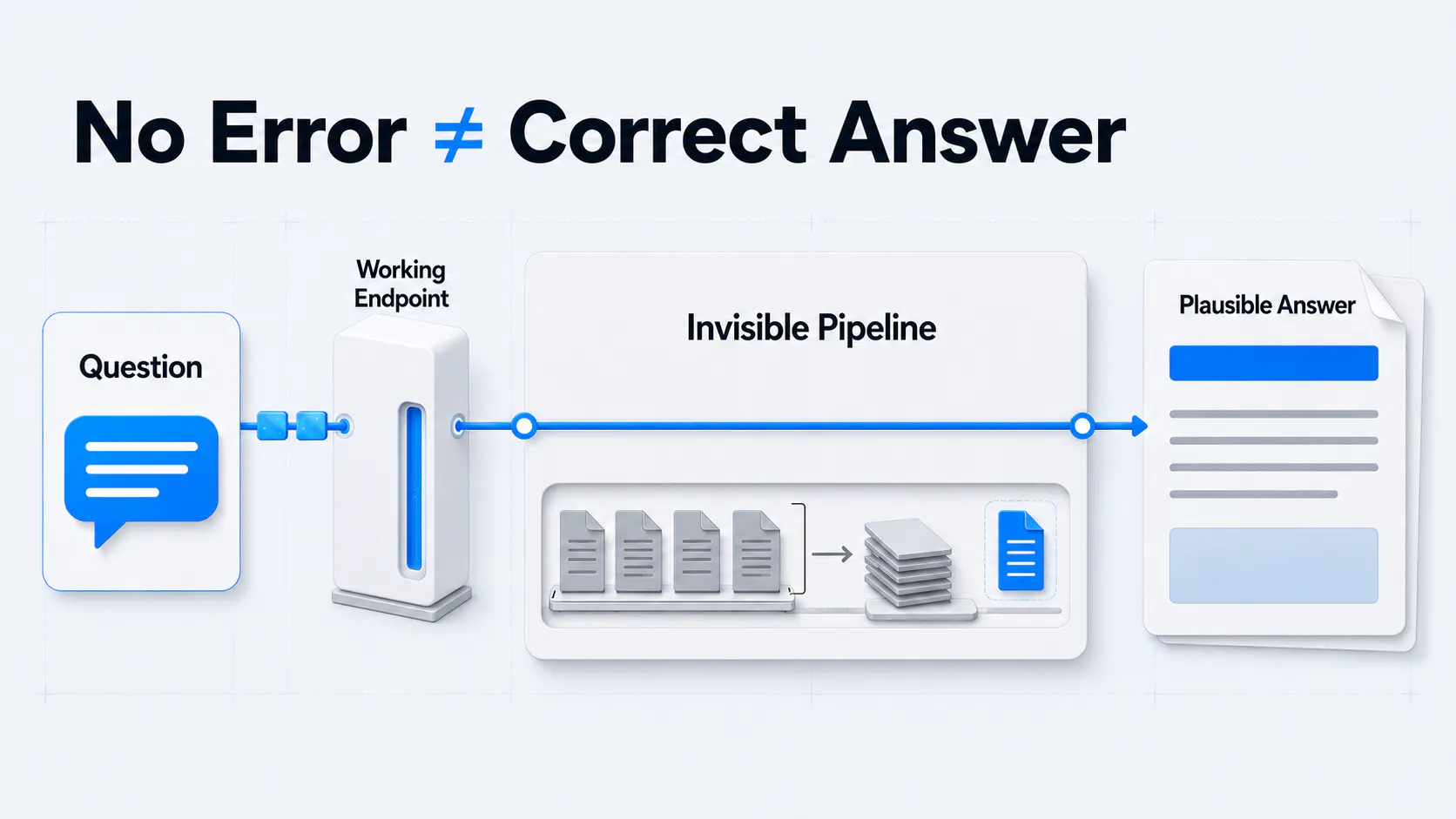
RAG observability is the monitoring layer built on top of your RAG infrastructure that lets you see what actually happens inside the pipeline - which chunks get retrieved, with what similarity scores, and whether the final answer is faithful to the retrieved context. Without it, you only see two things: the question that went in and the answer that came out. Everything in between stays invisible.
You built a RAG system. It answers questions. No errors, no failed requests - so why does it feel like you have no real read on whether it's actually doing its job?
That feeling is the whole problem. A working endpoint and a correct answer are not the same thing, and most teams only find out the difference when a user complains.
When RAG Quietly Breaks
Here's a situation that plays out in some version at almost every team building production RAG.
A team builds an internal knowledge base for customer support. Standard setup: documents get chunked, embedded, pushed into a vector database, and a retrieval pipeline feeds the top matches into an LLM as context. The first two weeks look great. Demo works, stakeholders are happy, support agents start using it.
Then complaints start trickling in. Answers are vague. Sometimes they're confidently wrong. A few times, the system answers a completely different question than the one asked. Nothing in the logs flags it.
A developer opens the code. The retrieval call looks fine. The prompt template looks fine. Everything looks correct, and that's exactly the trap: when the system is silently wrong instead of loudly broken, you have no entry point for debugging.
This is the moment teams realize their RAG infrastructure has a gap - and it isn't a bug you can fix with a code review.
Why RAG Is a Black Box Without Observability
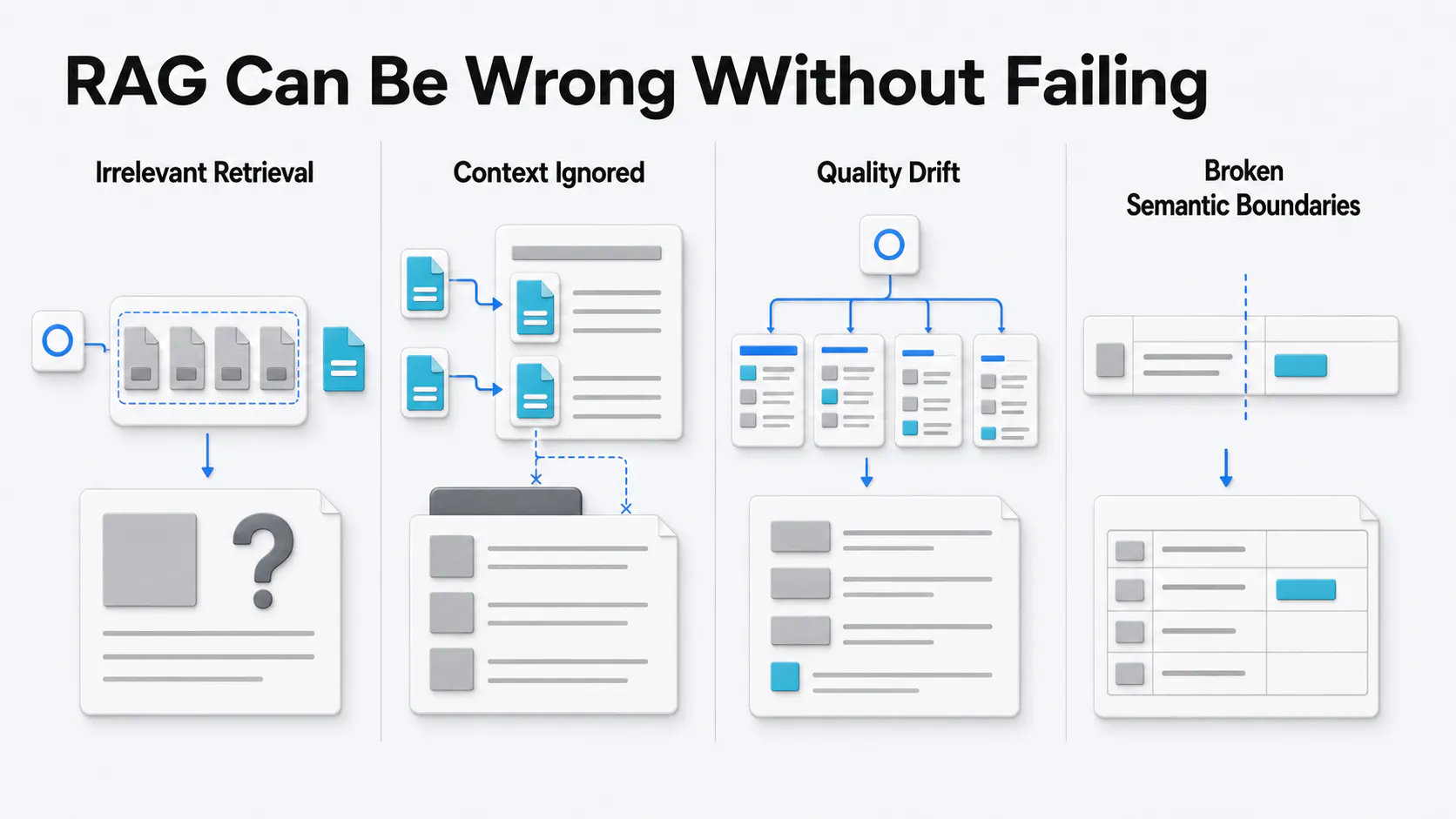
The issue isn't that RAG is unreliable. It's that a typical pipeline gives you almost no visibility into why it produced a given answer. Three failure modes show up constantly, and none of them throw an error.
Retrieval returns irrelevant chunks. The vector database returns the top-k nearest neighbors by similarity score, but "nearest" doesn't always mean "relevant." The LLM still has to produce something, so it stitches together an answer from whatever context it received - fluent, confident, and wrong.
Retrieval is correct, but the LLM ignores the context. This is the classic hallucination-on-top-of-truth scenario. The right chunks made it into the prompt, but the model answers from its own weights instead of grounding itself in what you gave it. From the outside, this looks identical to a retrieval failure - same symptom, completely different root cause.
Retrieval quality degrades gradually. After a document update, a re-chunking pass, or a model swap, retrieval quality can quietly decline over weeks. Similarity scores are one of the more visible symptoms - their distribution often drifts downward - but the underlying drop is in what's actually being surfaced as relevant, not just in a single number. Nobody's watching it, and by the time someone notices, the system has been underperforming for a month.
Chunking quietly breaks semantic boundaries. This one rarely gets blamed, but it's often the actual root cause behind the other three. A chunking strategy tuned for short FAQ-style documents will mangle long-form contracts or pricing tables - splitting a clause from its condition, or a number from the row label that gives it meaning. The retrieval pipeline still returns something with a reasonable similarity score, so nothing looks obviously wrong. The chunk is just missing the one sentence that would have made the answer correct.
Notice the pattern across all four: every one of them produces a fluent, plausible, confidently-worded answer. None of them produce an error. That's precisely why teams underestimate how exposed their RAG infrastructure is - the failure mode isn't a crash, it's a wrong answer that reads exactly like a right one.
If your pipeline includes a reranking step - Cohere Rerank, Voyage, a cross-encoder - it's worth remembering that's just one more place where the same failure mode can hide: a reranker that consistently demotes the right chunk produces an identical symptom to bad retrieval.
A retrieval pipeline without this kind of insight is production code without logs.
What to Actually Measure
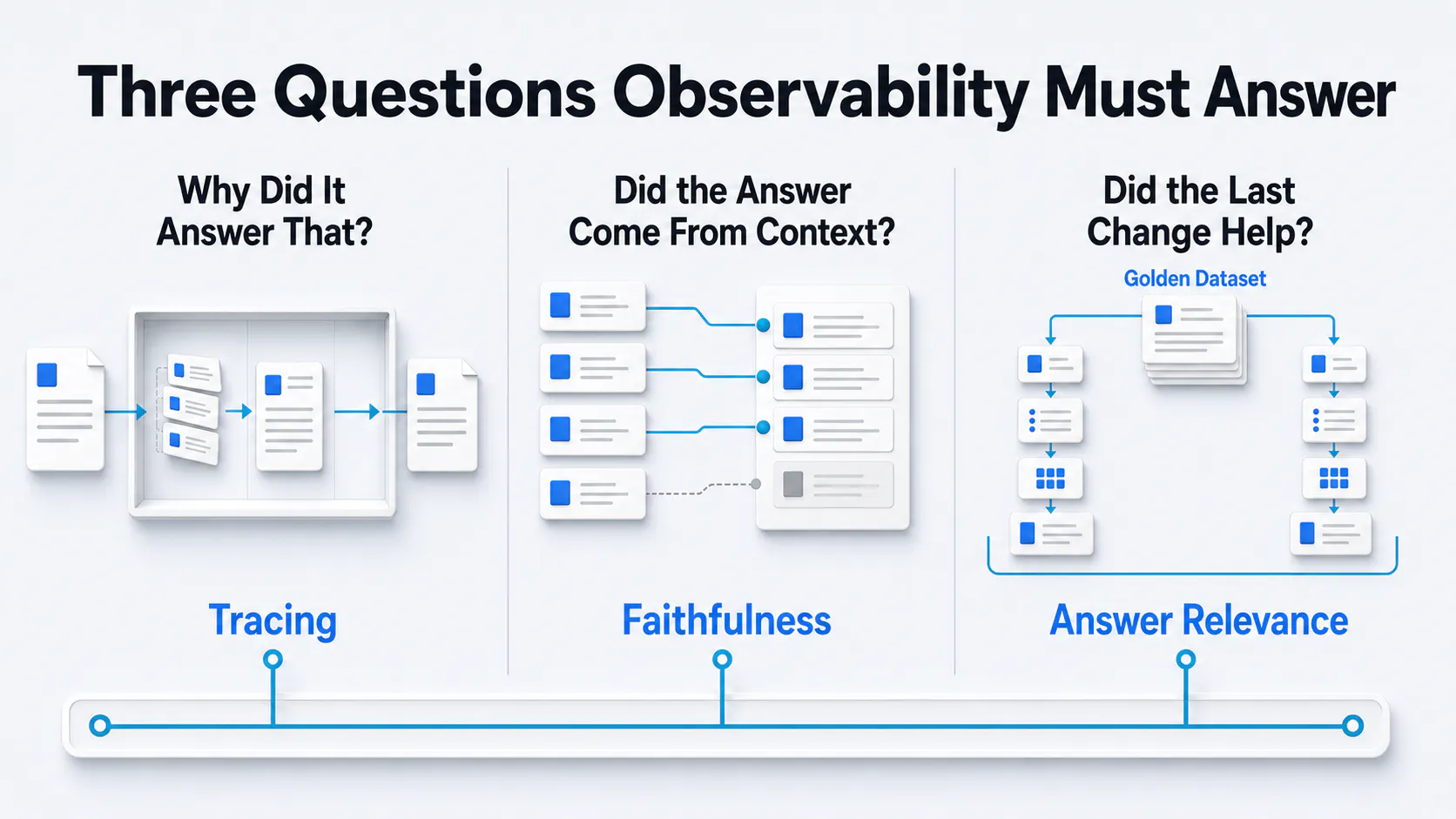
Forget the textbook three-tier breakdown of tracing, metrics, and alerting for a second. In practice, you're trying to answer three questions a developer actually asks when something feels off.
"Why did it answer that?" This is tracing. You need the full path of a single request: the query as received, the chunks retrieved with their similarity scores, the exact prompt assembled and sent to the LLM, and the response that came back. Without this trace, you can't tell whether the problem started at retrieval or at generation - you're just looking at an input and an output.
"Did the answer actually come from the context, or did the model make it up?" This is faithfulness - a metric that checks whether claims in the generated answer are actually supported by the retrieved chunks. Low faithfulness alongside high-quality retrieval is a strong signal the model is ignoring context. Low faithfulness alongside poor retrieval points the other way - the chunks likely weren't useful to begin with, though it's worth confirming rather than assuming.
"Did our last change make this better or worse?" This needs answer relevance scored against a golden dataset - a fixed set of maybe 50 representative questions with known-good answers that you run after every meaningful change: a new chunking strategy, an embedding model swap, a reranking step added to the pipeline. Without this benchmark, every change is a guess.
You don't need all of this on day one. The minimum that already pays off: end-to-end tracing on a single request, plus a faithfulness score. That alone turns "something's wrong" into "here's specifically what's wrong." Everything else - recall metrics, drift alerts, automated regression suites - gets added once that foundation exists. This is really where the RAG integration infrastructure starts to mean something concrete: it's not just a vector database bolted to an LLM, it's the tracing, evaluation, and logging layer that wraps around both.
One more thing worth flagging, even briefly: this gets harder once your pipeline stops being a single retrieve-then-generate hop. Agentic RAG setups - multi-step retrieval, tool calling, MCP-based workflows - chain several decisions before producing an answer, and a wrong turn at step two of five is much harder to spot than in a single pass. That's a topic for its own deep dive, but the short version is: the more steps in the chain, the less optional tracing becomes.
The Tool Stack: What to Actually Pick
There's no shortage of tools here, and most comparisons just list features. What actually matters is the trade-off each one makes - and worth saying upfront: the specific names below will likely shift faster than the underlying need for them. The principle (trace everything, evaluate against a fixed benchmark) outlasts any individual vendor.
For tracing:
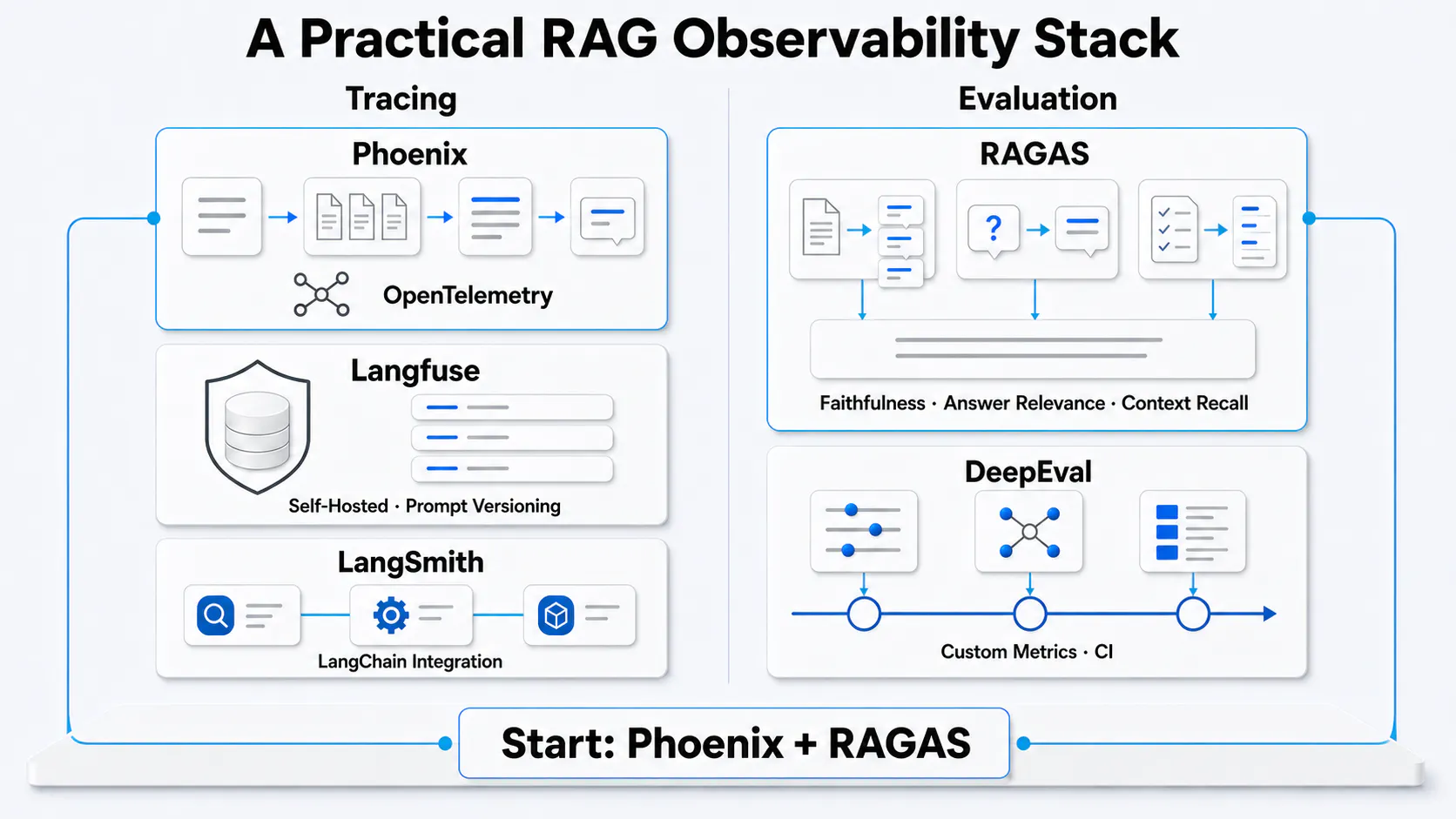
- Phoenix (Arize) is the default recommendation for most teams. It's source-available under the Elastic License 2.0 - free to self-host and use, though that license is more restrictive than MIT or Apache 2.0 if you ever wanted to offer it as a managed service yourself. Built on OpenTelemetry, so you're not locked into a proprietary trace format. The UI is genuinely good for digging into a single bad trace and seeing exactly where retrieval or generation went sideways - you can click into a request, see the retrieved chunks ranked by score, and inspect the assembled prompt without writing a custom dashboard.
- Langfuse makes sense when data privacy is non-negotiable - fully self-hosted, no data leaves your infrastructure, and it has an active community shipping integrations quickly. It also handles prompt versioning well, which matters once multiple people are editing the same prompt template and nobody can remember which version caused last week's regression.
- LangSmith is the obvious pick if you're already deep in the LangChain ecosystem and want tight integration without extra wiring. The trade-off is vendor lock-in, and costs climb fast once you're tracing real production volume rather than a handful of dev requests.
None of these are mutually exclusive with the others in theory, but in practice, pick one. Running two tracing tools in parallel just means two dashboards nobody fully trusts.
For evaluation:
- RAGAS is the de facto standard for the metrics themselves. Faithfulness, answer relevance, context recall - it covers about 80% of what most teams actually need, and it's the fastest way to get real numbers instead of vibes. Worth knowing upfront: it's a metrics library, not a platform - there's no UI or production monitoring built in. You run it and feed the scores into whatever you're using for tracing, which is exactly why pairing it with Phoenix or Langfuse is the common pattern rather than running it standalone.
- DeepEval is worth reaching for when RAGAS's built-in metrics don't fit your domain and you need custom evaluation logic - for example, scoring against company-specific compliance language or building a metric that checks whether an answer includes a required disclaimer. It also integrates more naturally into a pytest-style CI workflow if you want retrieval regressions caught the same way you'd catch a failing unit test.
If you're starting from zero, don't try to stand up the full stack at once. Phoenix plus RAGAS gets you running in a day, and the payoff is immediate: the next bad-answer complaint becomes a five-minute trace lookup instead of an hour of guessing at the code. Add Langfuse or DeepEval later if a specific gap shows up; don't pre-build observability for problems you don't have yet. The goal of any RAG integration infrastructure investment early on is coverage, not completeness.
Back to the Scenario: Observability in Action
Let's return to the support team from earlier - same product, same complaints, but now with Phoenix and RAGAS wired into the retrieval pipeline.
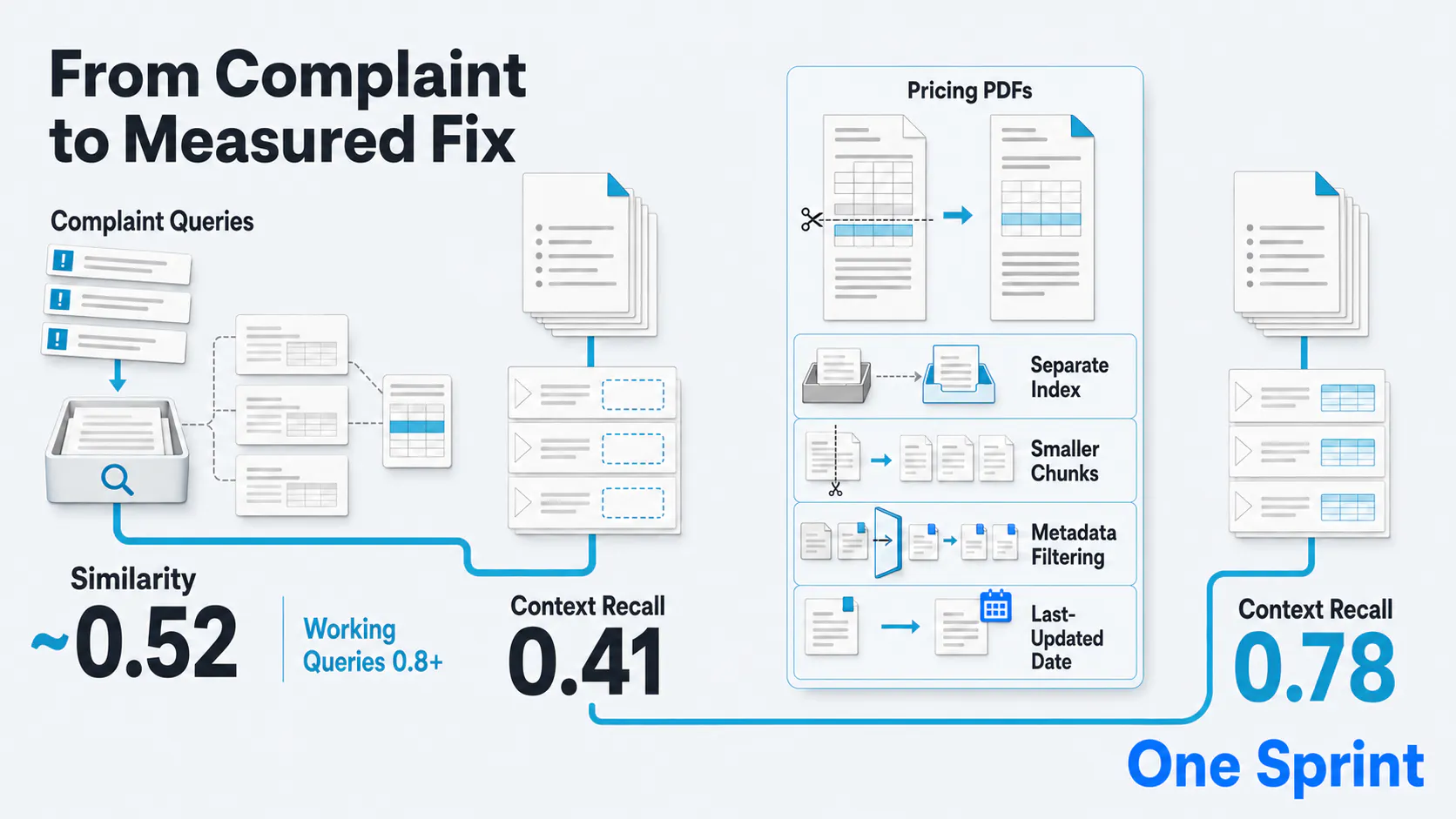
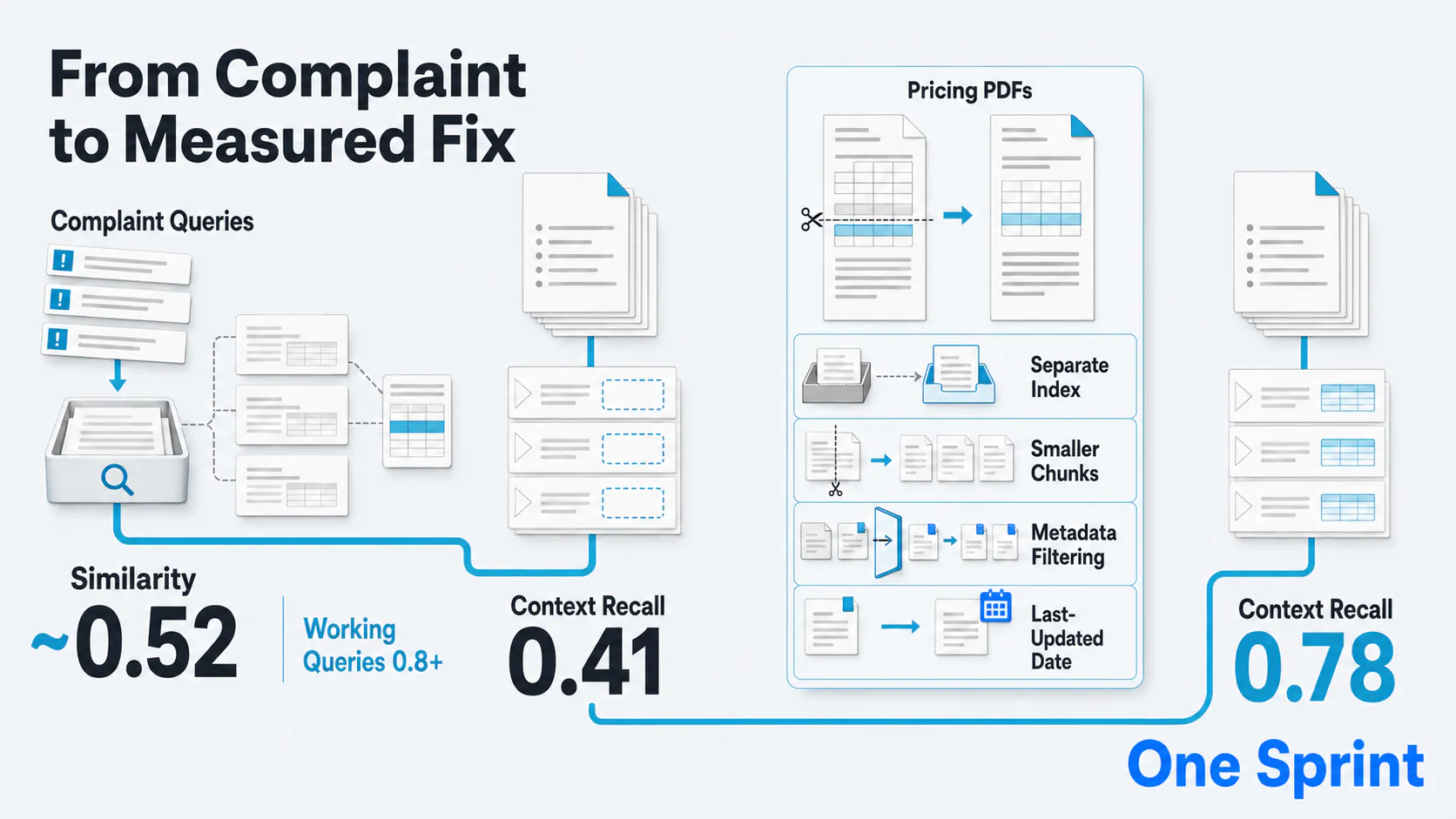
Step one: they open the traces for a handful of complaint-flagged queries about pricing. The chunks being retrieved are coming back with similarity scores around 0.52 - noticeably lower than the 0.8+ scores on queries that work fine.
Step two: they run RAGAS context recall against a small golden dataset of pricing-related questions. It comes back at 0.41. Translation: the information needed to answer correctly often isn't even making it into the prompt. This isn't a generation problem - it's a retrieval problem, confirmed with a number instead of a hunch.
Step three: they form a hypothesis. The pricing documentation lives in long, unstructured PDFs that got chunked the same way as everything else - large chunks, no metadata tagging. Pricing tables and conditional clauses are getting split across chunk boundaries, and important context is getting buried in irrelevant surrounding text. A quick look at a few raw chunks confirms it: one chunk ends mid-table, right before the row that actually answers the user's question.
Step four: the fix is targeted, not a full pipeline rewrite. They build a separate index for pricing documents, reduce chunk size specifically for that content type, and add metadata filtering by document_type so pricing queries can be biased toward the right index instead of competing with general FAQ content for the same top-k slots. They also tag each pricing chunk with the document's last-updated date, which turns out to matter later when finance updates the pricing page mid-quarter.
Step five: context recall on that same golden dataset jumps from 0.41 to 0.78 in one sprint. Complaints about pricing answers drop sharply the following week, and - just as importantly - the team now has a number they can point to in the next retro instead of a vague "it feels better."
This is the actual value of observability - not that it prevents every mistake, but that it turns "something's not right" into "here's exactly where and why," with numbers to prove the fix worked. Without the trace and the recall score, this same fix would have shipped as a guess, and nobody would know for certain whether it actually helped until complaints either kept coming or didn't.
Adding Observability to an Existing RAG Infrastructure
If you already have a system running, you don't need a big rebuild to get visibility. A few practical moves:
- Start with tracing on a single request. Wire up end-to-end tracing before anything else - it alone gives you most of the diagnostic value, and it's the smallest possible first step.
- Run evaluation as an offline batch job first. Don't bolt real-time scoring onto your live request path on day one; it adds latency risk for marginal early benefit. Run RAGAS against a batch of logged queries instead.
- Build a golden dataset early. Fifty representative questions with verified-correct answers is enough to start catching regressions. It becomes the benchmark every future change gets measured against.
- Sample instead of logging everything at scale. On high-traffic systems, tracing 10–20% of requests is usually enough to catch patterns without drowning your storage or your evaluation pipeline in volume.
None of this requires re-architecting your retrieval pipeline. It's additive - a layer wrapped around what you already have.
The Bottom Line
So, how do you know if your RAG actually works? You trace one request end-to-end, you score it for faithfulness, and you stop guessing.
Most teams pour their effort into building the RAG infrastructure itself - the vector database, the chunking logic, the prompt templates - and treat monitoring as an afterthought, something to add "once it's stable." But stability isn't something you can confirm by reading code. It's something you measure.
Real RAG integration infrastructure means tracing, evaluation, and logging aren't bolted on after launch - they're part of the system from the start. You don't need the full stack today. You need one traced request, one faithfulness score, and the discipline to look at both before assuming everything is fine.