


LLM deployment cost optimization is the practice of reducing inference costs while maintaining output quality across production AI systems. In 2026, the core strategies include model routing (directing requests to the most cost-effective model), context caching (up to 90% savings on repeated prompts), quantization (3x throughput at lower hardware cost), and RAG data hygiene (reducing context window bloat by 3–5x). The primary metric is CPSO - Cost per Successful Outcome - rather than raw token cost. Hybrid deployment combining managed LLM services with self-hosted SLM models typically reduces cost per task by 70–80% compared to frontier-model-only approaches.
LLM Deployment Cost Optimization in 2026: Real Numbers and Strategies
The Era of Inference Inflation
In 2024, companies feared falling behind without AI. In 2026, they fear the invoice.
I have seen production systems where the monthly bill for LLM deployment grew eightfold in six months - not because of audience growth, but because of a complete lack of control. This pattern - inference costs rising faster than business value from already-running LLM model deployments - goes by several names in the industry: inference cost growth, AI spending explosion. I call it Inference Inflation, though that is an author's term rather than an established industry standard.
Alongside it came what is convenient to call Shadow AI Spend - borrowing directly from the well-known Shadow IT concept. Different departments rack up uncontrolled costs: marketing connects its own LLM services, developers test various LLM deployment methods in production environments without any monitoring. In large teams, anywhere from 5% to 50% of token spend is wasted (Token Waste). In my experience the typical range is 15–40%, but no universal benchmark exists.
Real savings do not come from hunting for the cheapest LLM model. They come from adopting AI FinOps: understanding the ROI of every request and maintaining strict token hygiene.
Stop Paying for AI Blindly
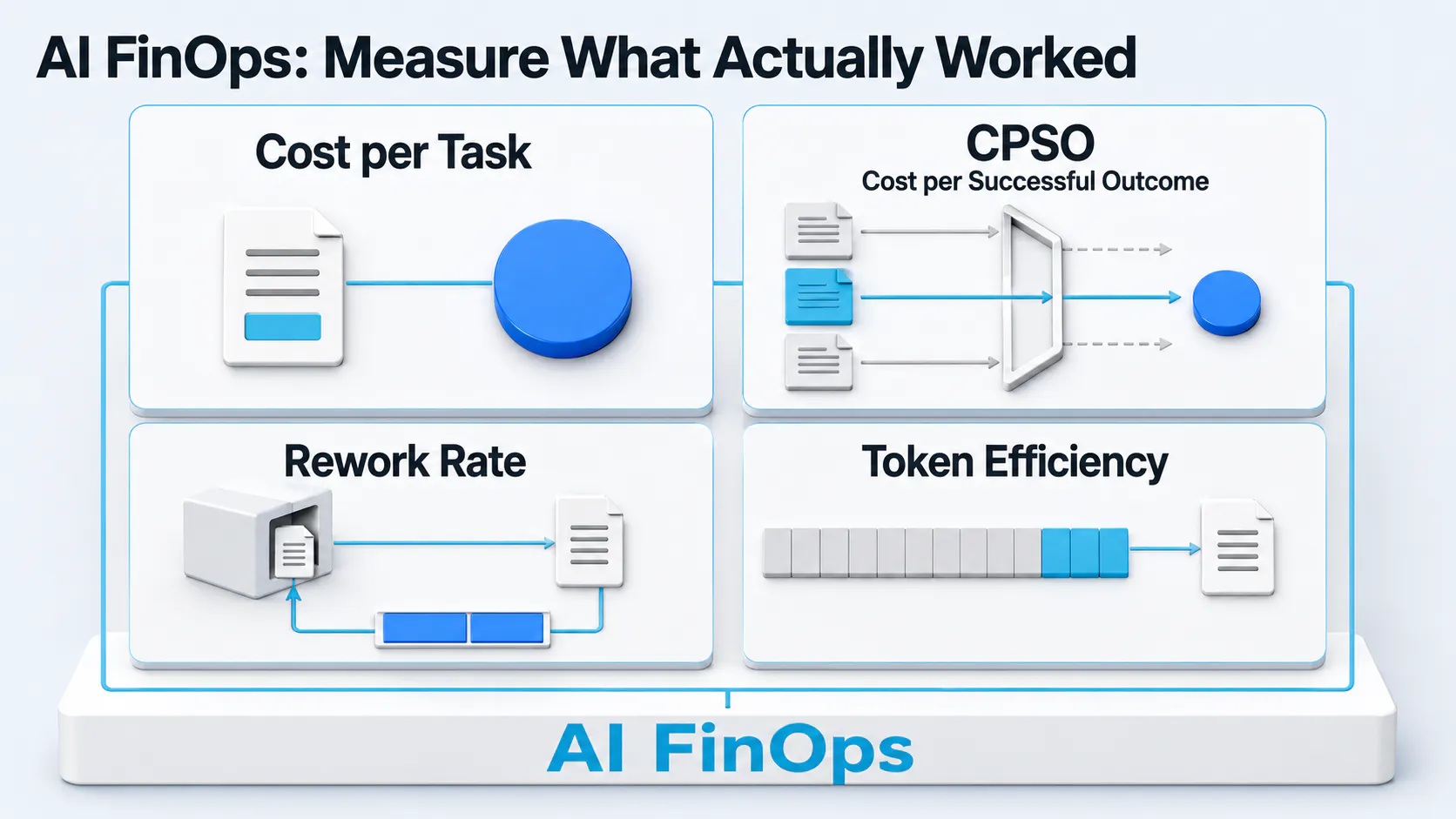
AI FinOps is the discipline of managing inference economics. Without it, any LLM deployment becomes a financial black hole. Where we once optimized cloud services and compute, the unit of control is now every transaction with an LLM model. This shift requires new KPIs.
Cost per Task - what a single business function actually costs. Not "how much did we spend on the LLM model this month," but the cost of generating one product description, processing one support ticket, or answering one customer query.
CPSO (Cost per Successful Outcome) - the cost of only the results the business accepted. Different companies use different names: Cost per Resolution, Cost per Task, CPA. CPSO is an author's label for the same underlying principle: count only what actually worked, not everything generated.
Rework Rate - the share of budget spent fixing model errors or re-running requests. An acceptable threshold depends on domain: for high-volume e-commerce content, 10% is already a signal to optimize; for legal drafts or medical reports, 20–30% may be perfectly normal. The goal is to measure and track the trend, not chase a single universal target.
Token Efficiency - the ratio of useful payload to total tokens consumed. It reflects how well your prompt is structured and how clean the input data is for model processing.
AI FinOps turns the LLM from a black box into a transparent asset with a clear unit cost. In practice: every department using LLM services has its own cost center; every deployment has a clear budget owner; anomalous spending triggers automatic escalation. Once you learn to count properly, you discover that the biggest losses do not start in the models. They start in the data.
Why Bad Data Costs More Than a Bad Model
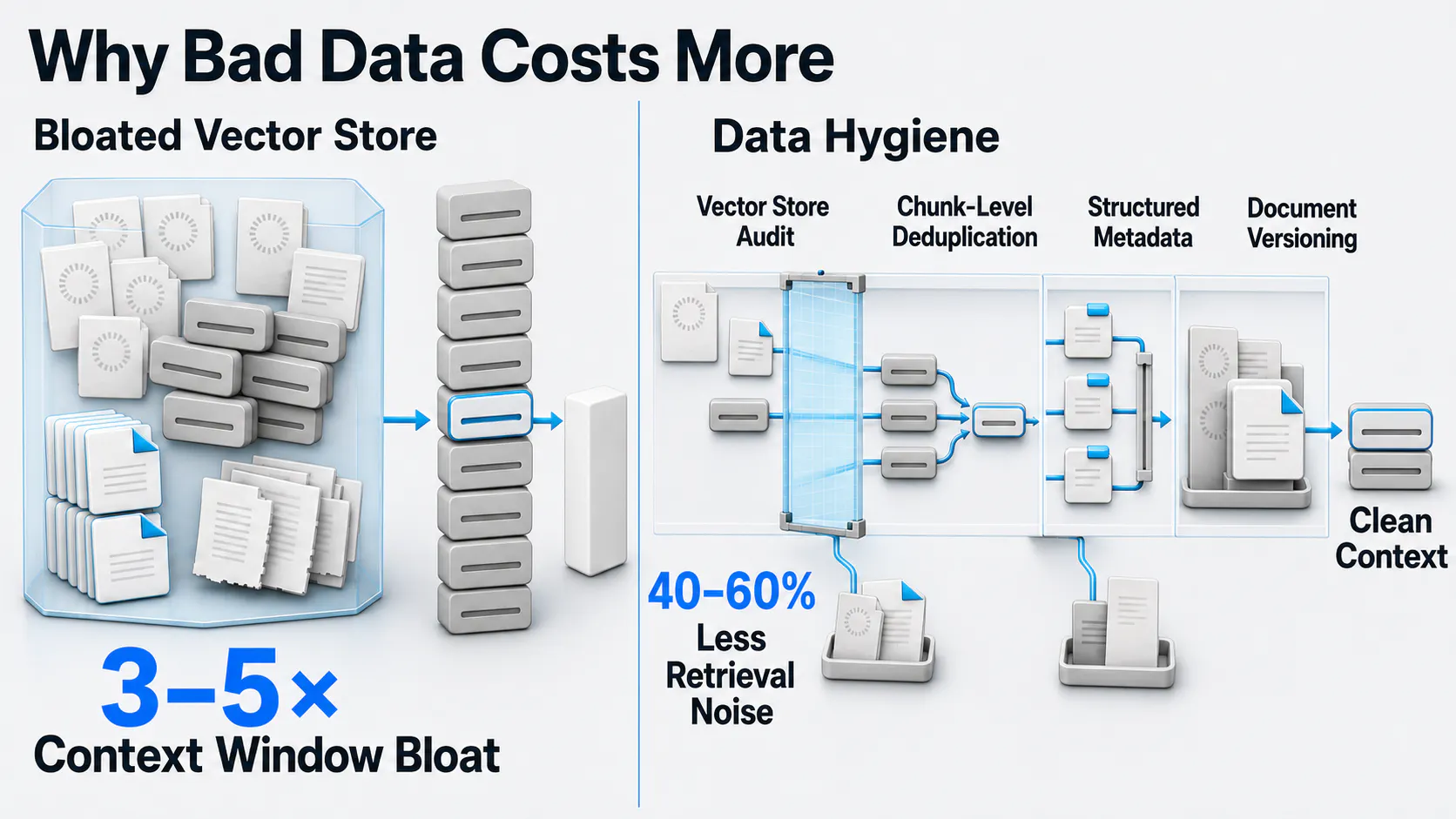
The real problem in LLM deployment in 2026 is Vector DB bloat. Teams load everything into the vector store: outdated documents, duplicates, drafts, old support logs. Retrieval noise grows with the database - the system pulls irrelevant fragments because similarity in vector space does not equal relevance to a business task. The result: the large language model processes enormous text volumes to find a few useful sentences. In production deployments, poor retrieval inflates the context window 3–5x, and the cost per LLM model request grows proportionally.
Investment in data quality pays back disproportionately fast - regardless of project context. In some teams, cleaning the vector store cut costs fivefold; in others, twentyfold.
Practical data hygiene steps for LLM deployment:
Vector store audit - remove documents past a defined age threshold or below a relevance score. Regular lifecycle management cuts retrieval noise by 40–60%.
Chunk-level deduplication - check semantic similarity before indexing. Prevents the accumulation of duplicates that bloat the context window.
Structured metadata - proper document tagging lets you filter retrieval before the vector search, reducing the number of candidates passed to LLM model processing.
Document versioning - keep only the current version with rollback capability. Critical for compliance-sensitive deployments.
Clean data means shorter prompts, fewer tokens, and a smaller bill for LLM services.
The Right Model Is Not the Smartest - It Is the Most Appropriate
The traditional split between "small model" and "large model" is blurring. The market is moving toward mixture-of-experts, dynamic reasoning, and adaptive compute: modern models already vary compute based on request complexity. This makes routing more important, not less - the orchestration layer now decides which model to call and how much compute to allocate.
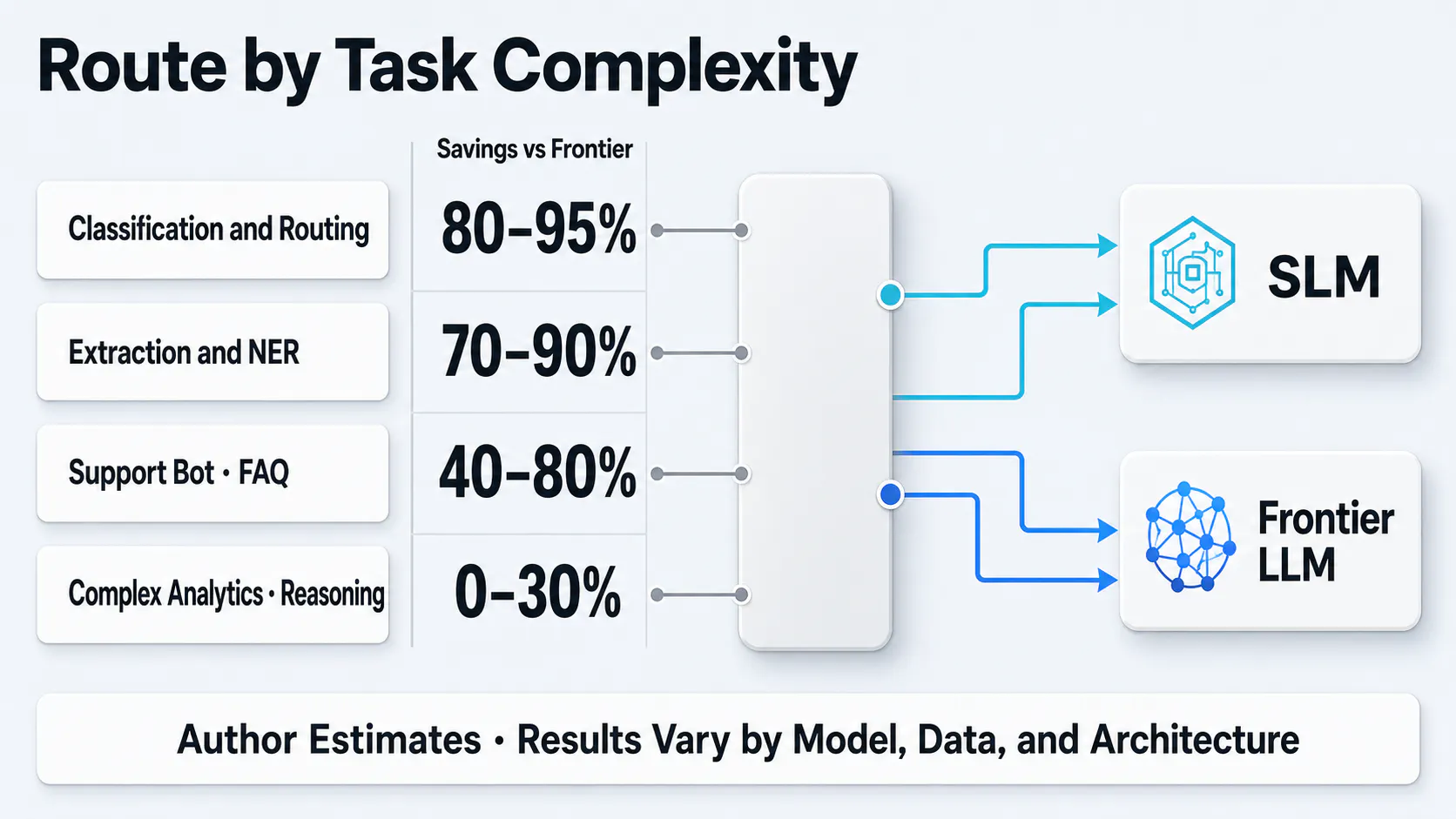
Real savings from SLM depend on task type. Ranges below are the author's estimates based on practical experience; results vary with specific models, data, and architecture:
| Task Type | Savings vs Frontier |
|---|---|
Classification and routing | 80–95% |
Extraction and NER | 70–90% |
Support bot, FAQ | 40–80% |
Complex analytics, reasoning | 0–30% |
The claim "SLMs are cheaper" is only true for certain task classes. For complex reasoning, a frontier model may be the only option that delivers acceptable quality. This is where the Reasoning Budget concept comes in: sometimes it is more cost-effective to give an LLM model more time to generate a valid result on the first attempt than to pay for instant but incorrect answers that require Rework. This is one of the key methods for reducing real LLM deployment costs.
Model routing - distributing requests across LLM models based on complexity. Simple queries go to a cheap SLM; complex analytical cases go to a frontier LLM. The core strategy for scalable deployment with controlled costs.
Cascade architecture - the request starts with the smallest, cheapest SLM. If the confidence score falls below a threshold, it automatically escalates to a more capable model.
Adaptive inference - dynamic adjustment of compute resources per request in real time. Flexible balance between latency and LLM deployment costs.
There is no single right LLM model. There is a right orchestration layer.
Caching and Quantization: Configure Once, Pay Less Forever
With routing in place, it is time to activate the technical levers.
Context Caching. A typical production system carries a system prompt of 1,500–3,000 tokens. Without caching, you pay to process it on every request. At 10,000 requests/day with a 2,000-token prompt at $2 per million tokens, that is $40/day for re-processing the same instructions. Context caching stores the static portion. Some providers - Anthropic and Google among them - offer up to 90% discount on cached tokens, but the exact coefficient, TTL, and billing model differ per platform. At Anthropic, cache TTL is 5 minutes after last use; other providers range from minutes to hours. For high-frequency LLM deployment workloads the cache stays warm automatically; for batch processing with longer gaps, factor TTL into planning.
Quantization. Compressing an LLM model for deployment on cheaper hardware: int8 or int4 instead of float32, less powerful GPU, lower inference cost. Typical results for a 7B model: int8 delivers 2x throughput at ~99% quality; int4 delivers 3x throughput at ~97% quality. These are averages - actual degradation depends on the model, task, and quantization method. Some cases show int4 is nearly imperceptible; others show significant degradation. vLLM is the de facto standard for high-performance LLM model serving in production: quantization out of the box, efficient request batching, openai-compatible endpoints. TGI from Hugging Face is the alternative for Kubernetes environments, with built-in autoscaling and detailed metrics for observability.
Inference Hardware. In 2026, the hardware layer is a distinct variable in the LLM deployment cost equation. Specific chip generations will change every year, but the principle stays: hardware choice directly affects TCO. NVIDIA Blackwell (B100/B200) delivers 2–4x higher inference throughput versus the previous generation. AMD Instinct MI300X with 192 GB HBM3 keeps large models entirely in memory - critical for latency-sensitive deployments. Specialized accelerators (Groq LPU, Cerebras) show throughput an order of magnitude above GPU for certain workloads. The same token volume costs differently on different hardware - build this into any TCO calculation for self-hosted LLM deployment.
Prompt Architecture: Fewer Tokens, Same Quality
If quantization and caching optimize at the LLM infrastructure level, prompt architecture optimizes at the level of every model request.
Structured prompts - XML or JSON instead of long prose instructions. The advantage is not that the model "understands faster" - it receives fewer tokens, adheres to format more reliably, and handles constrained generation better.
Compressed system prompts - removing polite filler, redundant explanations, and duplication. I have trimmed system prompts by 40–60% with no noticeable degradation in LLM model output. The model responds to commands, not requests.
Context pruning - dynamically removing irrelevant conversational history before sending the request to the LLM. In multi-turn deployment scenarios: keep only the last N complete exchanges plus a concise summary in key-fact format.
Reusable templates - cached templates for recurring tasks. Define the template once, swap in only the variable part per request.
Output constraints - strict limits on format and length. If you need a JSON object with five fields, specify it. The model will not generate surrounding explanation, and your deployment pipeline will not waste resources on it.
The cheapest token is the one the LLM model never generated. Every unnecessary output character is a direct hit to product margin.
Counting the Cost of an Outcome, Not a Token
In 2026, LLM deployment efficiency is measured by the cost of a completed business task, not the cloud services bill. Three formulas every team needs when building LLM deployment strategies:
Request Cost with Cache: (uncached tokens × full price) + (cached tokens × price × 0.1). Often produces surprisingly low numbers for systems with large static contexts.
Self-hosted LLM 1M Cost: TCO of infrastructure / total generation volume. TCO includes hardware depreciation, electricity, networking, storage, and MLOps salaries. Missing any component makes self-hosted deployment look cheaper than it is.
CPSO: Total costs / Number of successful outcomes - not generated, not sent, but accepted by the business without rework.
Case study: e-commerce catalog automation, 1,000 product descriptions - 500 input tokens and 300 output tokens each. Numbers are illustrative; actual values depend on the specific model, prompt, and input data quality:
| Metric | GPT-only | Hybrid Routing | Self-hosted SLM |
|---|---|---|---|
CPSO | $0.12 | $0.035 | $0.012 |
Human Correction Rate | 2% | 5% | 9% |
Total cost | $120 | $35 | $12 |
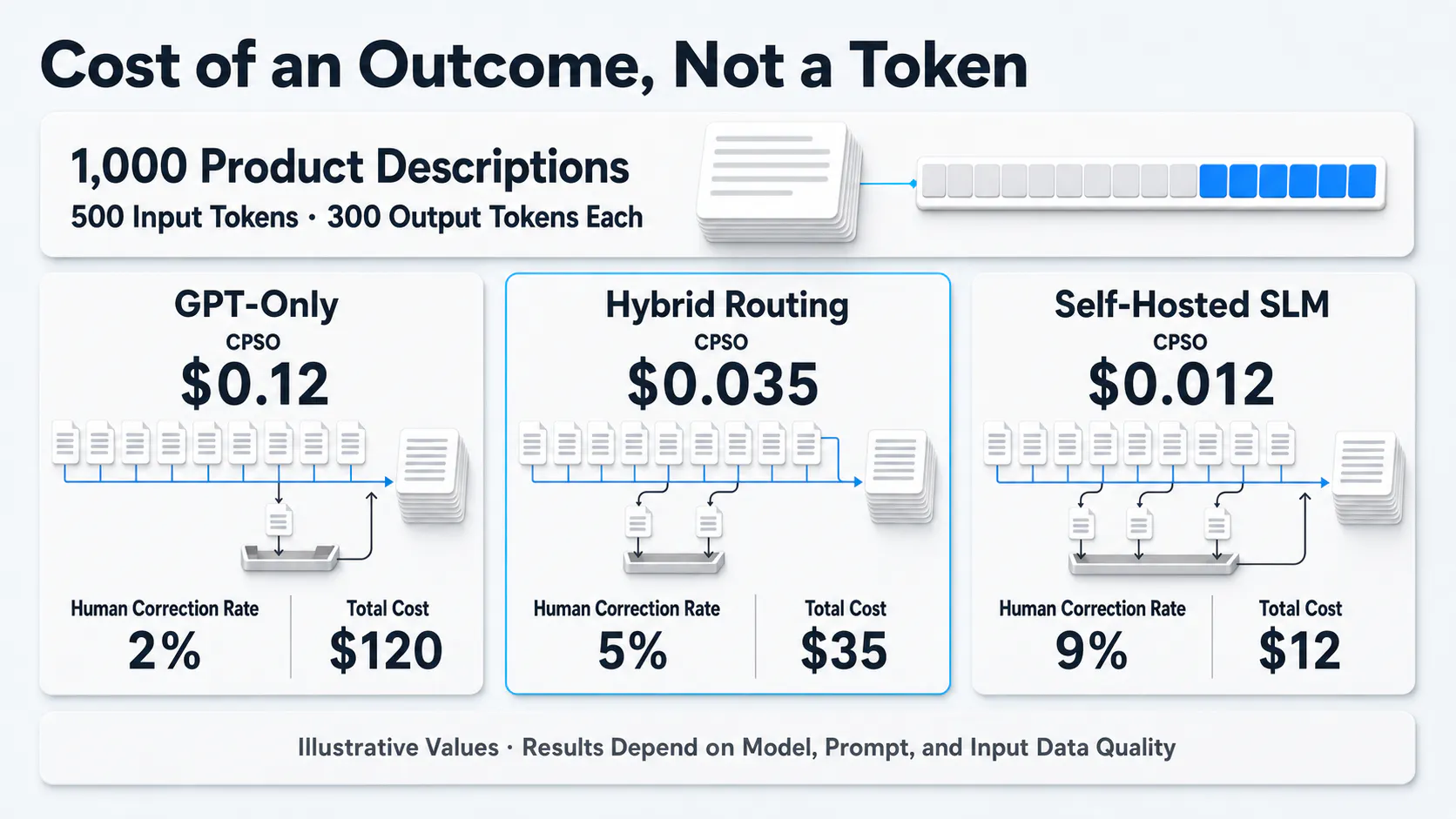
Hybrid Routing hits the sweet spot: frontier LLM quality at a price close to local deployment. Self-hosted SLM delivers the lowest token cost, but the higher Human Correction Rate means hidden labor costs that never appear in the LLM services invoice. Count the cost of a result that needs no rework - not the cost of tokens.
Multi-Agent Systems: Where Uncontrolled Costs Hide
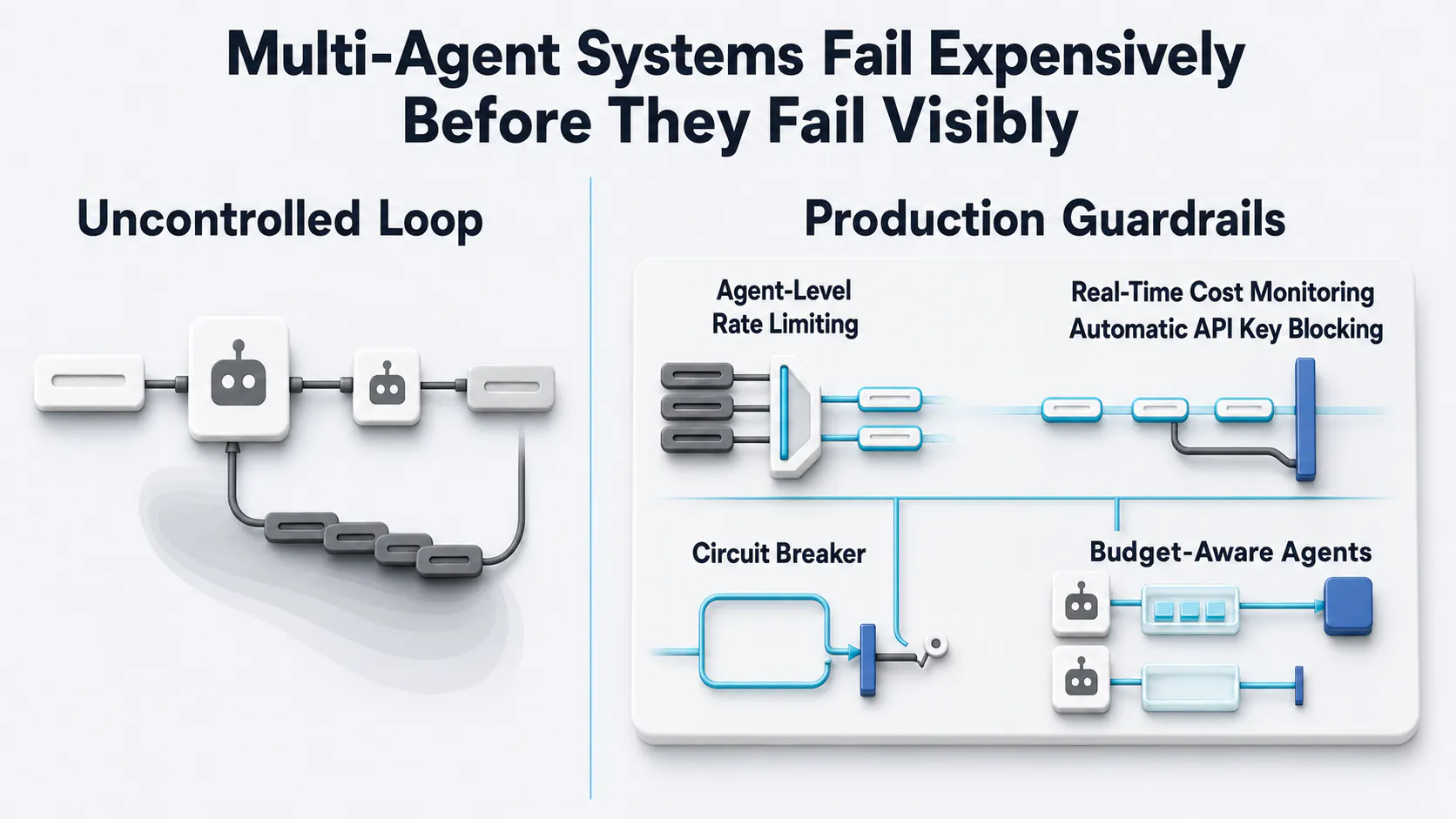
Multi-agent LLM deployment is both the most exciting and the most dangerous trend of 2026 from a cost management perspective. When agents autonomously plan actions and delegate subtasks, a specific risk emerges - infinite loops. A single logic error in the orchestration layer triggers a cascade of recursive model requests: an agent tries to fix a minor detail, calls a sub-agent, gets an unexpected result, retries - thousands of times within minutes. I have seen a production LLM deployment where this burned a month's budget overnight, with no alert in the logs.
"Multi-agent systems fail expensively before they fail visibly."
Required elements of any production multi-agent LLM deployment:
Rate limiting at the agent level - hard cap on requests to the model per unit of time. Not "recommended" - mandatory.
Real-time cost monitoring with automatic API key blocking on anomalous spend spikes. Observability at the level of individual model calls, not just aggregated metrics.
Circuit breaker in orchestration logic - automatic shutdown when the budget threshold is exceeded. Stopping production for five minutes costs less than an unexpected invoice.
Budget-aware agent design - each agent knows its spend limit before escalating to a more expensive LLM model.
API vs Self-Hosted: Finding Your Break-Even Point
After optimizing data and architecture, a strategic question arises: continue renting third-party APIs or invest in dedicated LLM deployment services built around your infrastructure?
SaaS API: low entry threshold, zero hardware operational costs, automatic scaling, model updates without team involvement. But the per-token price is fixed - for regulated industries, compliance often demands a secure on-premise LLM deployment.
Self-hosted GPU or LPU: fixed unit cost after the initial investment, full control over LLM model and data, fine-tuning capability. But high upfront hardware spend and full operational ownership: your team manages the entire lifecycle from provisioning to security patches.
Break-even is not a fixed number. It depends on model size (7B vs 70B), GPU generation (A100 vs Blackwell), utilization rate (30% makes a server three times more expensive per token than at 90%), MLOps salaries, and SLA requirements. Calculate TCO for your specific workload - do not rely on an industry benchmark.
BYOC (Bring Your Own Compute) - an intermediate deployment strategy: your own hardware through a managed platform without full infrastructure responsibility. Standard stack: Kubernetes with autoscaling, containerization via Docker, vLLM or TGI as the inference engine, openai-compatible endpoints for smooth migration between LLM providers.
Owning the server in 2026 is like owning an apartment after years of renting - high entry cost, but a fixed low price for years. Only if you ran the break-even math correctly.
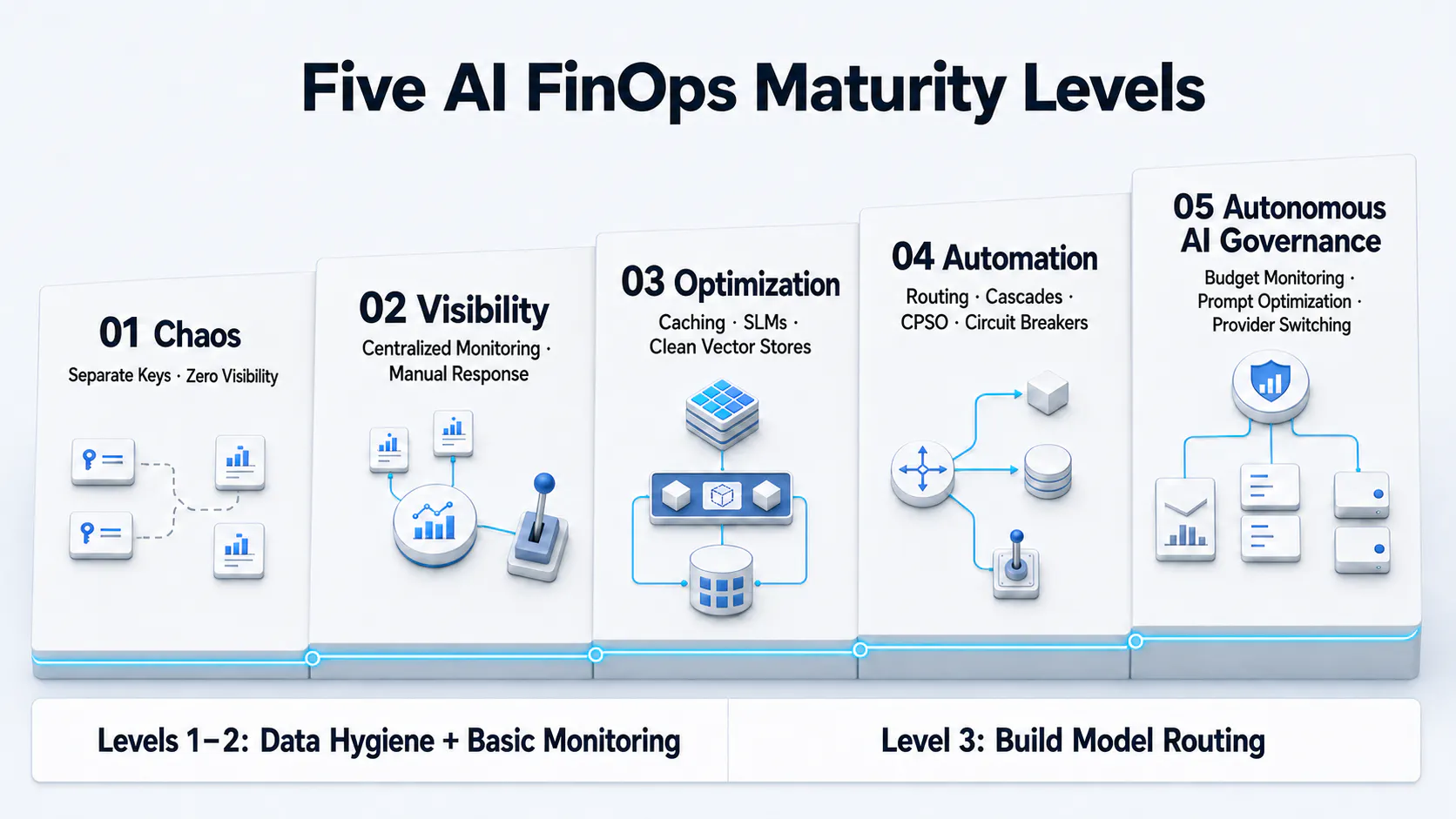
Where Is Your Team Right Now? Five AI FinOps Maturity Levels
Instead of a checklist - self-diagnosis by symptoms.
Level 1 - Chaos: separate LLM API keys per department, zero visibility into services spend, deployment without testing or staging environments. Shadow AI Spend is the norm.
Level 2 - Visibility: centralized monitoring exists but anomaly response is manual. The team sees Token Waste but lacks strategies to address it. Cost per Task tracked inconsistently.
Level 3 - Optimization: context caching active, SLMs handling routine LLM workloads, vector stores regularly cleaned. Configuration management across environments. Rework Rate declining.
Level 4 - Automation: model routing and cascade architecture distribute LLM deployment workloads automatically. CPSO is the primary metric. Circuit breakers active; the system selects the optimal deployment path.
Level 5 - Autonomous AI Governance: LLM deployment systems autonomously monitor budget, optimize prompts in real time, switch between cloud providers for the best CPSO. Full lifecycle management from model versioning to scalability testing.
Teams that do not count tokens today will not scale tomorrow.
What Changes When Inference Becomes Cheap
A few scenarios that look most probable - forecasts, not facts.
Inference will likely become a commodity: GPU capacity turns into a utility like electricity - unit price trends toward zero while consumption grows exponentially. The question shifts from "can we afford these LLM services" to "are we using them efficiently."
Routing will matter more than models: the winner is not who has the smartest LLM, but who most efficiently routes tasks across specialized models. Model routing becomes the defining deployment competency.
AI Ops specialization is deepening. Distinct roles are already forming: AI Infrastructure Engineer, FinOps Engineer focused on inference costs, AI Operations Lead. Whether this becomes a standalone mass profession remains to be seen, but the specialization trend is clear.
From Cost to Profit: companies will stop optimizing cost per token alone and start measuring profit per inference - not "how much did we spend on LLM deployment" but "how much did we earn per model request."
One thesis that will survive past 2027: do not optimize the price of a token - optimize the cost of a useful outcome. Most teams lose money here: they cut inference costs 70%, then spend those same dollars on manual corrections and re-generations.
In 2027, the winner will not be the team that saved on tokens. It will be the team that taught its LLM to generate profit on every iteration.
If your team is at level 1–2 - start with data hygiene and basic deployment monitoring. Fastest ROI. At level 3 - build model routing architecture. Everything else follows with scale.


Let's arrange a free consultation
Just fill the form below and we will contaсt you via email to arrange a free call to discuss your project and estimates.